The dance explained
Khmer classical dance and the apsara
What Khmer classical dance is, where the apsara comes from, how hand gestures, characters, music and costume work, and what to watch for on the night.
Book an Apsara evening ↗Quick answer
Khmer classical dance is the Cambodian court dance that UNESCO lists as the Royal Ballet of Cambodia. It tells legends through codified hand gestures, four character types, an orchestra and a chorus. The apsara is one character, modelled on the dancing figures carved at Angkor, and the Apsara dance seen today was created in the 1950s under Queen Sisowath Kossamak. Watch the hands first: they carry the story.
What Khmer classical dance is
Khmer classical dance is renowned for its graceful hand gestures and its elaborate costumes. UNESCO has listed it as the Royal Ballet of Cambodia since 2003 and says it has been closely associated with the Khmer court for over one thousand years and is seen as a symbol of Khmer identity. Its repertory retells legends about the origins of the Khmer people. Performances traditionally accompanied royal ceremonies such as coronations, marriages and funerals, as well as Khmer holidays. In Khmer the tradition is called Robam Preah Reach Troap, which Wikipedia translates as the dance of royal wealth. Wikipedia notes that UNESCO and many scholars use Royal Ballet of Cambodia and Khmer classical dance for the same tradition, although the first term may also refer to the National Dance Company of Cambodia.
Where the apsara comes from
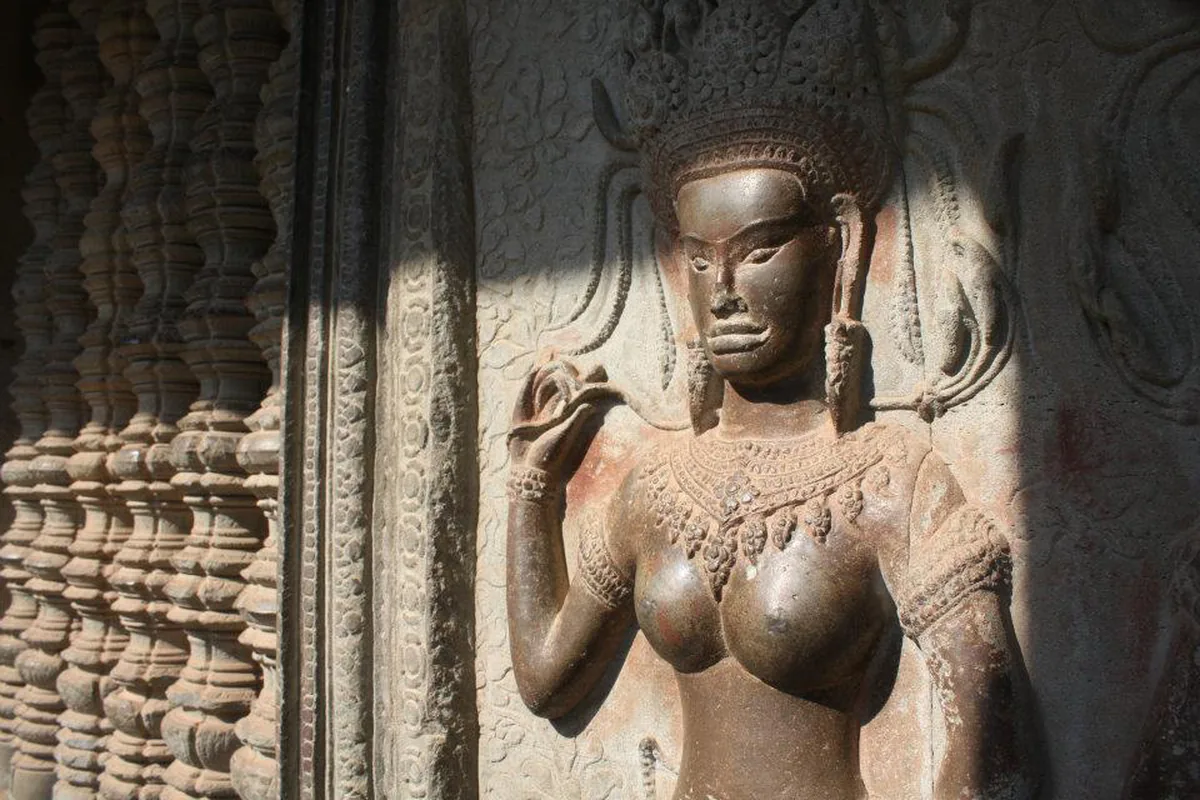
An apsara is a celestial being in Hindu and Buddhist culture, pictured as beautiful and elegant and said to excel at dancing. Apsaras were originally a type of female spirit associated with clouds and water. She is an important motif in the stone reliefs on the temples of Angkor, built between the 8th and 13th centuries. In Khmer art, a female figure who dances or is poised to dance counts as an apsara, whereas one who stands still, facing forward like a temple guardian, is a devata. So not every carved woman at Angkor is an apsara. Apsaras also figure prominently in the sculpture, dance, literature and paintings of many South Asian and Southeast Asian cultures.
A newer dance with an old look
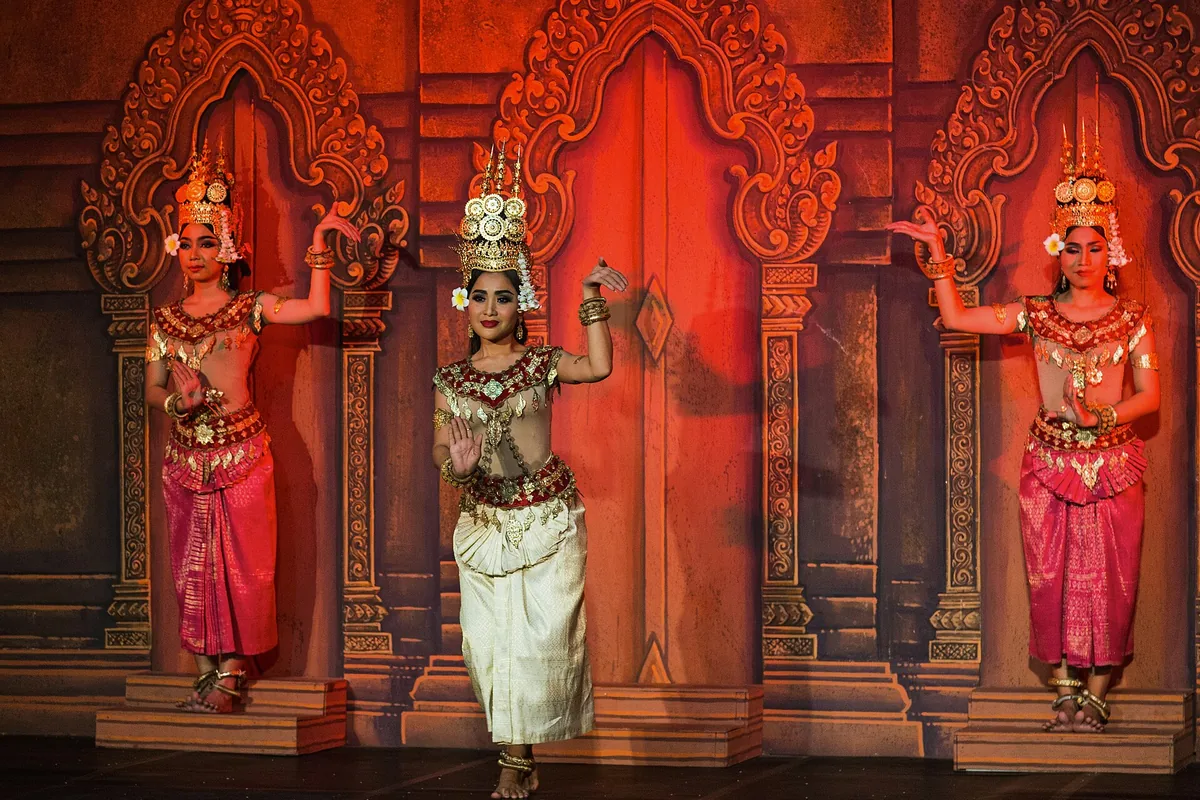
The Apsara dance on stage today is younger than the carvings. Wikipedia dates its creation to the 1950s, when Queen Sisowath Kossamak re-created it, drawing on the apsaras of Angkor for the crown, the sampot and the flower. It describes Robam Tep Apsara as one of the traditional dances of the Royal Ballet of Cambodia repertoire, performed by women sewn into tight-fitting traditional dress, whose graceful, sinuous gestures are codified to narrate classical myths or religious stories. It is one of the national symbols of Cambodia. The costume is based on the apsaras in the bas-reliefs of the temple ruins, while much of the music and gesture is shared with other classical Khmer dances.
The hand alphabet
Hand gestures in Khmer classical dance are called kbach, meaning style. They form a sort of alphabet and stand for things from nature such as fruit, flowers and leaves. Dancers use them in different combinations and transitions, with movements of the legs and feet, to convey different thoughts and concepts. The position of the arm, and of the hand relative to the arm, can change a gesture's meaning. Some gestures are easy to read and others are vague and abstract. Dancers do not sing or generally speak, and UNESCO adds that mastering the gestures takes years of intensive training. Gestures are performed in different manners depending on the character type. Some gestures are easily understood and others stay vague and abstract.
Four kinds of character
UNESCO names four distinct character types in the classical repertory, each with its own colours, costumes, make-up and masks, and the list below gives them. Queens, goddesses and princesses are the highest-ranking female roles, called neang ek. Other female characters, such as the apsara, the kinnari, a bird-woman, and the mermaid, dance in the style of the neang with subtle differences in gesture, and the main difference is the costume. Wikipedia lists the giants and the monkeys among the masked characters.
- Neang: the woman
- Neayrong: the man
- Yeak: the giant, who wears a mask
- Sva: the monkey, who also wears a mask
Dressed for the part
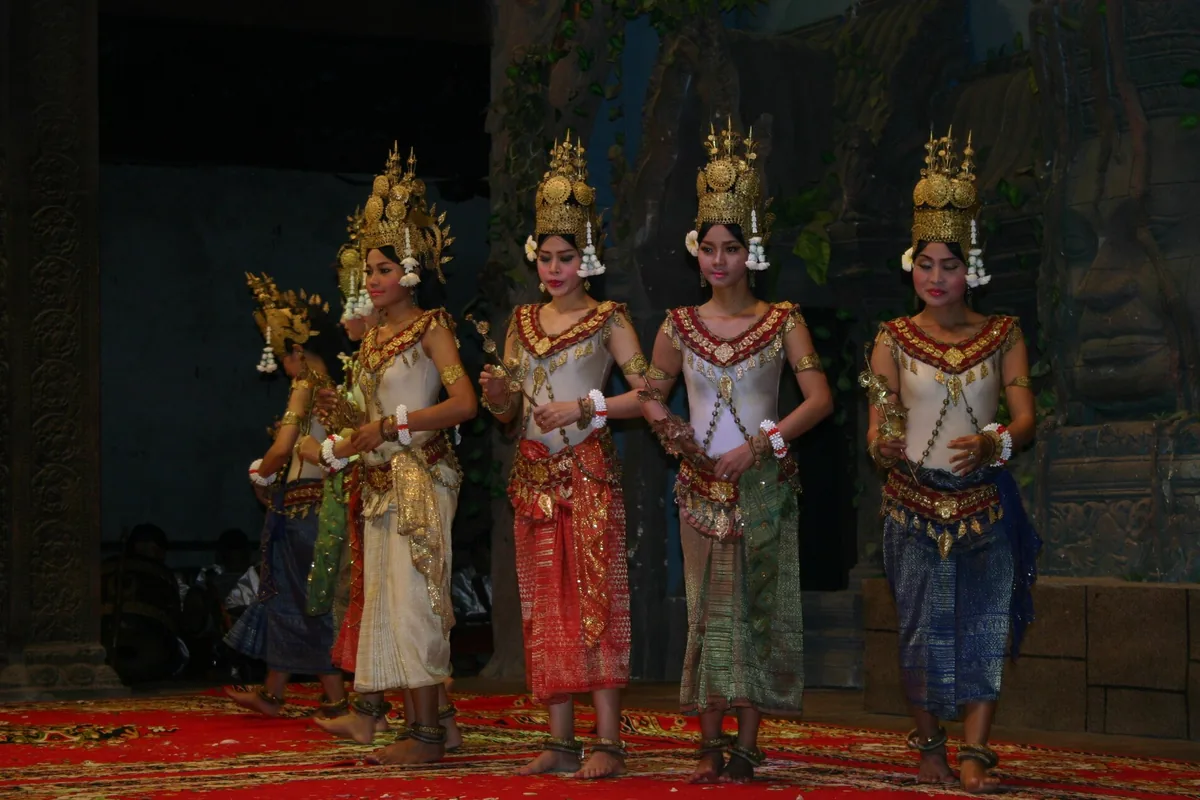
The costume is part of the language. It bears a lot of brocade and embroidery, and dressing a dancer means sewing the garments onto her, which takes multiple hours. Wikipedia adds that most of the costumes are thought to represent what divinities wear. For the apsara, the lead's sampot is generally white and the supporting dancers appear in green, blue or red. The lead apsara's headdress has three points with two rows of spherical decorations, like the apsara pictured at Angkor. Dancers traditionally wear fragrant flowers, and may wear jasmine garlands on their wrists. The costume guide on this site goes through the skirt-cloth, collar, crown and jewellery piece by piece.
Read next: Apsara costume and headdress
The orchestra and the chorus
UNESCO says an orchestra accompanies the dance and a female chorus provides a running commentary on the plot, highlighting the emotions the dancers mime. The orchestra is the pinpeat, the largest Khmer traditional musical ensemble, with approximately nine or ten instruments, mainly wind and percussion, including several varieties of xylophone and drums. Particular pieces of music mark particular events, such as a dancer's entrance or exit, or flying and walking, and new pieces are rarely created. Wikipedia says the pinpeat has accompanied court dances, masked plays, shadow plays and religious ceremonies.
Read next: Pinpeat: the music of Khmer dance
Court, temple and ceremony
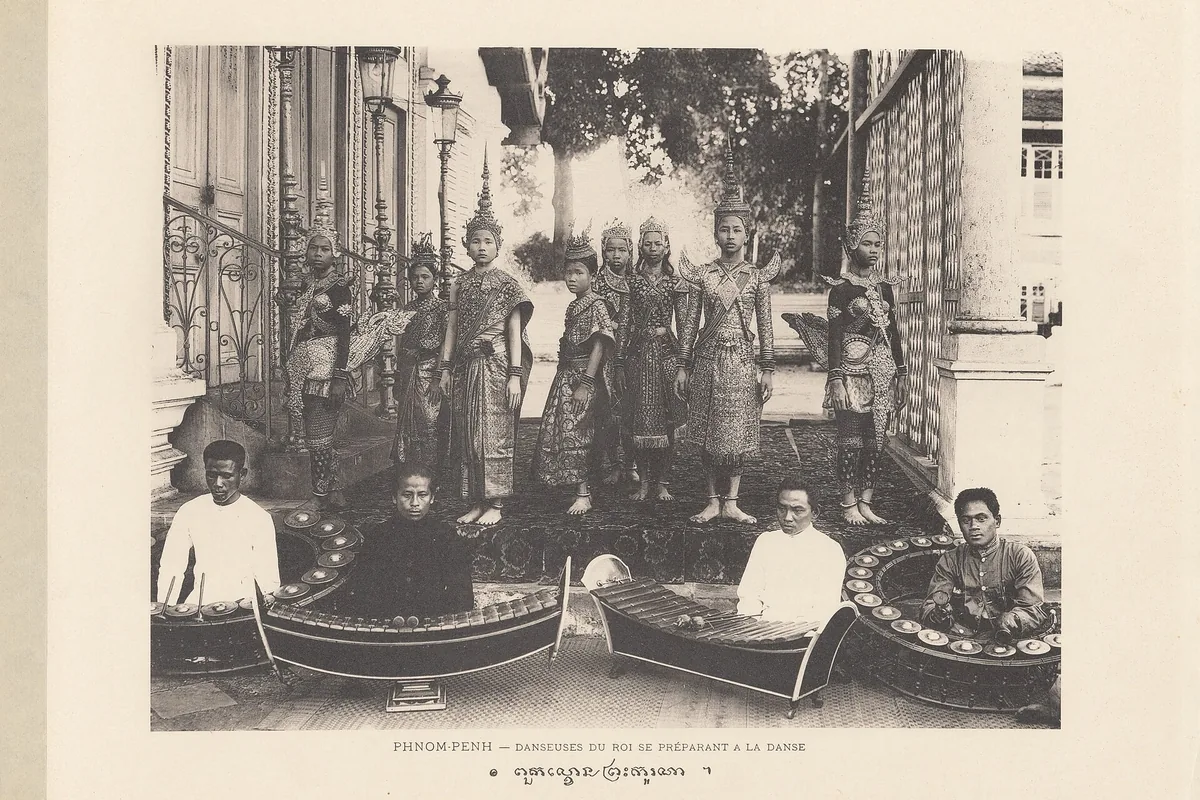
Dance has a long record in Cambodia. One of the earliest records is from the 7th century, when performances were used as a funeral rite for kings, and ancient stone inscriptions describe thousands of apsara dancers assigned to temples. In the court tradition, UNESCO says, dancers were seen as messengers of the kings to the gods and to the ancestors. Before a troupe enters the stage, a Teacher Salute Ceremony pays tribute to the teachers who trained the dancers and asks the spirit of each character to keep the performance smooth and unobstructed. In propitiation ceremonies, Wikipedia adds, the dance was performed at Wat Phnom, the Silver Pagoda and the Throne Hall of the Royal Palace.
Near loss and revival
The Khmer Rouge regime nearly wiped out the art form. UNESCO says its rule largely ended the Royal Ballet and that almost all master dancers and musicians were killed. Troupes re-emerged after 1979 and took up the ancient repertory again. According to Wikipedia, Khmer classical dance training was resurrected in refugee camps in eastern Thailand with the few surviving dancers, and many dances and dance dramas were recreated at the Royal University of Fine Arts. UNESCO adds that the ballet has regained much of its former splendour, yet funding is short, suitable performance spaces are scarce, modern media compete for audiences, and there is a risk of it becoming a mere tourist attraction.
What to look for as you watch
Start with the hands, then the feet, then the faces. The gestures carry the meaning, so follow the same few shapes as they return. Notice how the lead is dressed differently from the supporting dancers, and listen for the music changing as dancers enter and leave. A held pose is worth a look as well as a gesture in motion. Do not expect a fast show: the movement is slow, controlled and codified. One reviewer of the Phnom Penh evening called parts somewhat slow and repetitive but beautiful, which is a fair description of the form. If the programme or the emcee names a dance, note the name so that you can look it up afterwards, and let the first few minutes teach your eye what to follow.
Who this isn't for
It will disappoint anyone who wants fast spectacle, acrobatics or a plot told in words, because dancers do not sing or generally speak and the story lives in gesture and in the chorus. A short Apsara dance is also an introduction, not the whole tradition: the classical repertoire portrays mythology and traditional tales in dance dramas that run longer than any single dance, and Wikipedia describes the Royal Ballet's repertoire as containing many dances and dance dramas. For a full dance drama in a theatre, look for a season by the national company.
Frequently asked questions
Is every Khmer dancer an apsara?
No. People often call Khmer classical dancers apsara dancers, but the apsara is one character type among others in the repertoire.
How old is the Apsara dance?
In its present form it dates from the 1950s, when Queen Sisowath Kossamak had it re-created. Its costume follows the apsaras carved on the temples of Angkor.
What are kbach?
Kbach are the hand gestures of Khmer classical dance. They form a sort of alphabet and represent things from nature, such as fruit, flowers and leaves.
Are the dancers women or men?
Most roles are performed by female dancers. The monkey roles were transferred to men under Queen Sisowath Kossamak.
Is the dance on UNESCO's list?
Yes. UNESCO has listed it as intangible cultural heritage since 2003.
Do the dancers speak or sing?
No. Dancers do not sing or generally speak. A female chorus provides a running commentary on the plot.
Sources